You've rehearsed your answers. You know your resume cold. But if you're getting rejected from group interviews and can't figure out why, the problem might not be what you're saying—it's what you're doing while everyone else talks.
Group interviews screen people out fast, and a lot of that screening happens when your mouth is closed.
What's Actually Being Evaluated When You're Not Talking
How group interviews work: 3–6 candidates, one room, limited time
A group interview puts three to six candidates in the same room answering questions from one or more interviewers. The whole thing typically runs 30 to 60 minutes. In a 60-minute session with six candidates, you're realistically speaking for about 10 minutes total.
The standard questions—tell us about yourself, why do you want this role, describe a challenge you overcame—get asked to everyone in sequence. That means roughly 50 of those 60 minutes, you're sitting there listening.
Those 50 minutes count more than most people think.
Why interviewers watch you when you're not speaking
Group interviews are primarily used as a first-round filter. The goal isn't to uncover your strengths—that's what later rounds are for. The goal is to eliminate candidates who show clear red flags early. Think of it as a pass/fail screen for professional behavior.
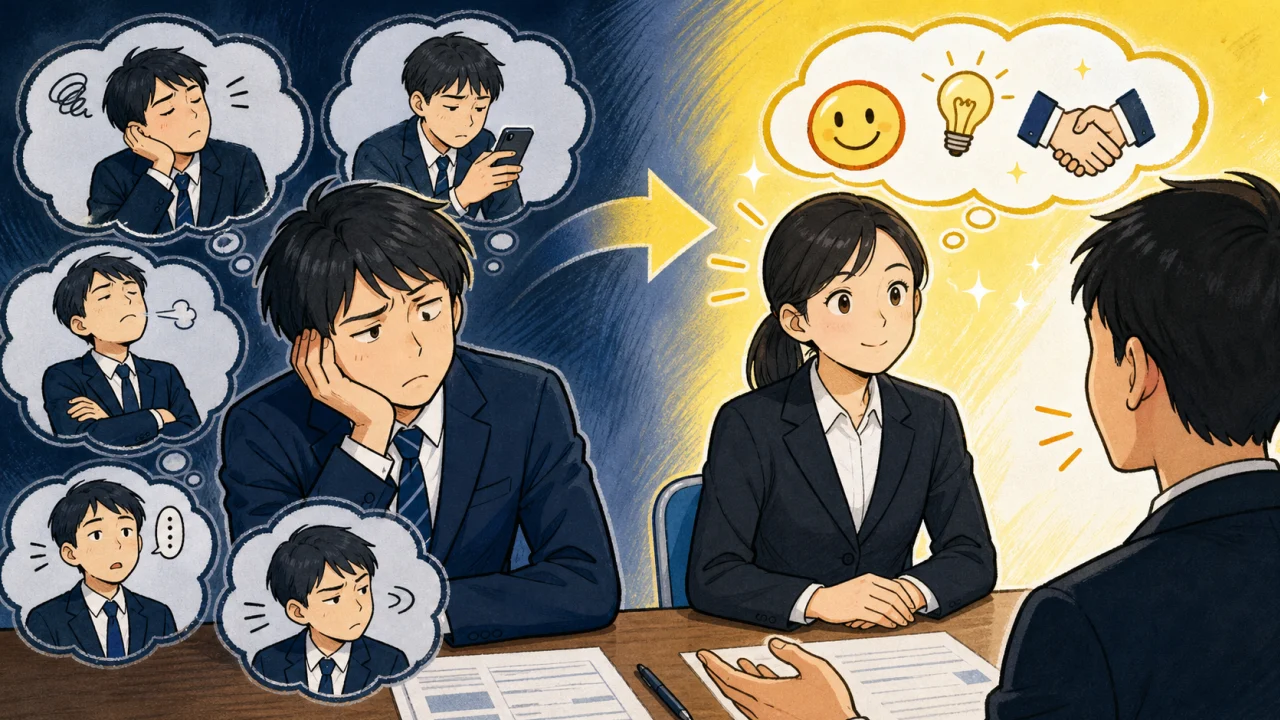
Picture a team meeting at work. Someone's presenting a project update, and one colleague is zoning out, fidgeting, or staring at the ceiling. You'd notice. So would their manager. Interviewers apply exactly that lens to candidates who aren't currently speaking.
The three things interviewers specifically watch for
When you're not answering a question, interviewers tend to track:
- Eye contact and posture — Are you facing the speaker? Is your back straight?
- Facial expression and reactions — Are you engaged? Nodding appropriately? Or blank-faced?
- Stillness — Are you calm, or are you fidgeting, clicking a pen, or visibly rattled by what someone else said?
None of this requires special talent. But under interview pressure, it's surprisingly easy to slip.
5 Listening Habits That Get You Cut in Group Interviews
Habit 1: Looking down the moment your answer ends
You finish your answer, exhale, and your eyes drop to your hands or the table. It feels natural—you're relieved it's over. But from the interviewer's perspective, you just checked out while your fellow candidate is mid-sentence.
In a group setting, this is relative. If four other candidates are tracking the speaker and you're staring at the table, the contrast is immediate and unflattering.
The fix is simple: keep your gaze around the speaker's face. You don't need to stare them down—occasionally glancing toward the interviewer reads as natural. Just don't disappear.
Habit 2: Getting lost in your own head preparing the next answer
You're so focused on drafting your next response that you completely miss what the person before you just said. You think you look focused. To the interviewer, you look disengaged.
This isn't a hypothetical risk. Some consulting firms have been known to ask candidates mid-session to summarize what a previous candidate just said. If you weren't listening, that's an instant credibility hit—regardless of how strong your own answers were.
Your answer prep belongs in the days before the interview, not during it. Once you're in the room, redirect that mental energy toward actually listening.
Habit 3: Letting boredom show on your face
When another candidate gives a long answer, it's easy to drift—and when you drift, it shows. A glazed expression, a glance at the clock on the wall, a subtle eye roll—interviewers catch all of it.
Group interviews aren't particularly long, but waiting through multiple answers can feel tedious. Candidates who visibly disengage during that wait tend to get flagged as poor team collaborators.
A practical trick: assign yourself a small listening task. Pick one keyword or idea from each person's answer and hold onto it. Having an active purpose keeps your expression engaged without forcing anything artificial.
Habit 4: Fidgeting with your pen or tapping the table
Nervous energy has to go somewhere, and for a lot of people it goes into their hands. Clicking a pen, spinning it between fingers, drumming fingernails on the table—these habits feel invisible to the person doing them and are highly visible to everyone else in the room.
One anecdote circulating in hiring circles: a recruiter at a large manufacturing company told a candidate after a group interview that the pen clicking had been noticed by everyone at the table. The candidate made it through that round—but the recruiter made clear it nearly cost them.
You won't break this habit by telling yourself to stop during a high-stakes interview. Practice in low-stakes settings, ask a friend to call it out, or record your mock interviews and watch your hands.
Habit 5: Visibly reacting when another candidate impresses (or stumbles)
Someone next to you rattles off an impressive story—led a 20-person team, launched a product, studied abroad for two years. Your face falls slightly. Or the opposite: another candidate trips over their words, and you can't hide a flicker of relief or surprise.
Either reaction signals that you're rattled by comparison. Interviewers are specifically watching for emotional stability during group settings—it's a proxy for how you'll handle real team dynamics.
Your story doesn't need to be the flashiest in the room. What you learned, how you acted, what you changed—that's yours alone. Competing on impressiveness is a trap. Stay steady, and let your answer speak for itself.
"Can You Summarize What the Last Person Said?" — The Listening Test You May Not Expect
It actually happens
As mentioned above, some interviewers—particularly at consulting and strategy-focused firms—will directly ask one candidate to recap what another just said. It's a deliberate check on active listening, and there's no graceful way to recover if you weren't paying attention.
Are you confident you could summarize the person before you right now?
How to retain key points without notes
Most group interviews don't give you paper to write on. So the skill to build is mental shorthand: pull one or two keywords from each answer and hold them.
If someone says they "led their college club's fundraiser and increased donations by 40%," you only need to remember "fundraiser—40% increase." Two anchors are enough to reconstruct a summary. You don't need the whole story.
Build this muscle outside the interview room: watch a short news segment, then explain the story to someone in 30 seconds. Do that consistently and you'll find it much easier to stay sharp during a 10-minute wait between your answers.
How to Actually Look Good When You're Not Talking
Nod—but don't overdo it
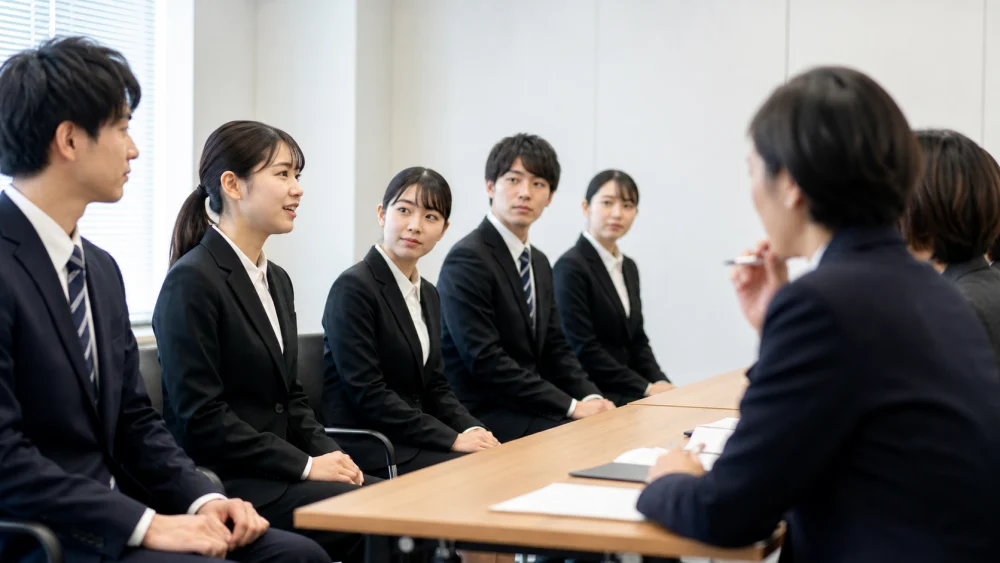
Face the speaker, and nod lightly at natural pause points in what they're saying. Once after a complete thought is about right. Nodding continuously like you're agreeing with everything regardless of content reads as performative and slightly odd.
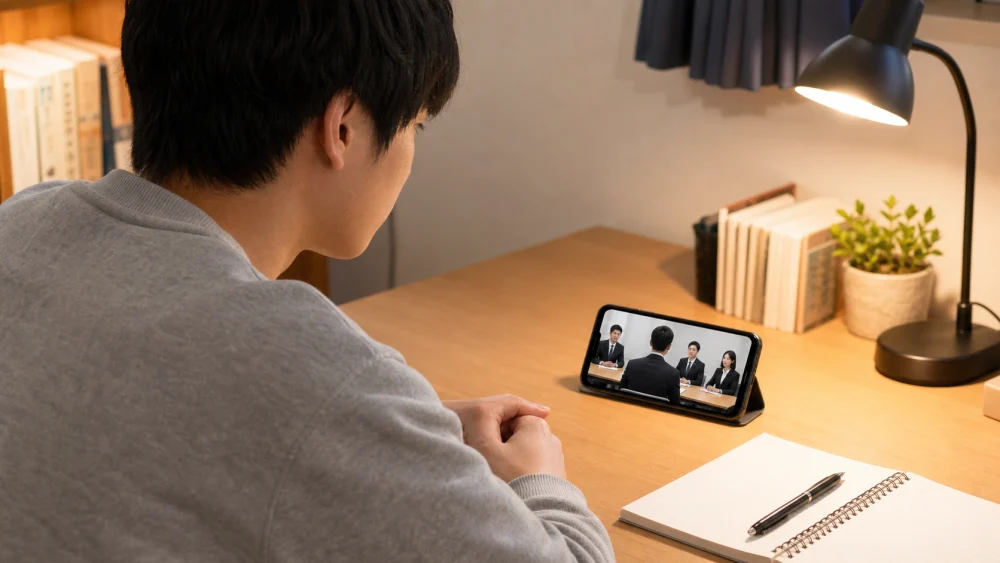
Online group interviews require a small adjustment
In a virtual group interview, the camera frames your face closely, which means your expressions carry more weight than they would across a conference table. A small nod that reads clearly in person might be nearly invisible on screen.
Go slightly bigger with your nods in a virtual setting—not exaggerated, just intentionally visible. And unless it's your turn to speak, stay muted. Background noise while someone else is talking is one of the fastest ways to leave a negative impression in an online format.
Staying sharp for the full session
A 30–60 minute group interview isn't long, but nerves are exhausting. The moment right after you finish your own answer is when most candidates mentally check out—and that's exactly when interviewers are watching to see how you transition back into listener mode.
Give yourself a small mission: "I'm going to take one thing away from each person's answer." Passive listening drains your attention. Active listening, even in a lightweight form, keeps you present and shows on your face.
Training Your Listening Before the Interview
Run a mock group interview with friends
Most people practice one-on-one interview prep. Fewer simulate the group format. Gather three or four people, assign one as the interviewer, and run through a realistic session. Ask the person playing interviewer to specifically watch and give feedback on what everyone's doing when they're not speaking. You'll surface habits you never knew you had.
Record yourself and watch the parts where you're not talking
Film your mock interview on your phone. When you replay it, skip past your own answers—those aren't what you're analyzing. Watch yourself while the other person speaks. Are you looking down? Is your posture collapsing? Is your face neutral to the point of looking checked out?
Seeing it on video hits differently than being told about it. Most people are genuinely surprised by what they see.
Preparing only your answers gets you halfway there. Checking how you listen gets you the rest of the way.
Frequently Asked Questions
What if another candidate gives the same answer I planned to give?
Don't panic and don't improvise a completely different answer on the spot—that usually backfires. Even if the topic overlaps, your specific experience, your reasoning, and your framing are different from theirs. Deliver your prepared answer confidently and in your own words. Interviewers understand that similar questions produce similar themes.
Are there signs during the interview that you're not going to move forward?
A few patterns get cited often: the interviewer stops directing questions at you, there's no follow-up on anything you said, or your total speaking time is noticeably shorter than everyone else's. That said, group interviews are naturally light on follow-up compared to individual rounds—so the absence of deep questions alone doesn't mean much. The clearer signals involve being visibly passed over.
What's more actionable: don't give the interviewer a reason to mark you down before you've even finished answering. Behavioral red flags during the listening portions can eliminate you before your answers even factor in.
How does a group interview differ from a one-on-one in terms of what they're looking for?
One-on-one interviews are designed to build a picture of your strengths. Group interviews are designed to filter out problems. In a one-on-one, a great answer can compensate for a slow start. In a group interview, a behavioral slip—checking your phone, visibly rolling your eyes, fidgeting through someone else's answer—can override everything you said.
That's why polishing your answers alone isn't enough. The candidates who pass group interviews are the ones who perform professionally for the full session, not just when it's their turn to speak.