
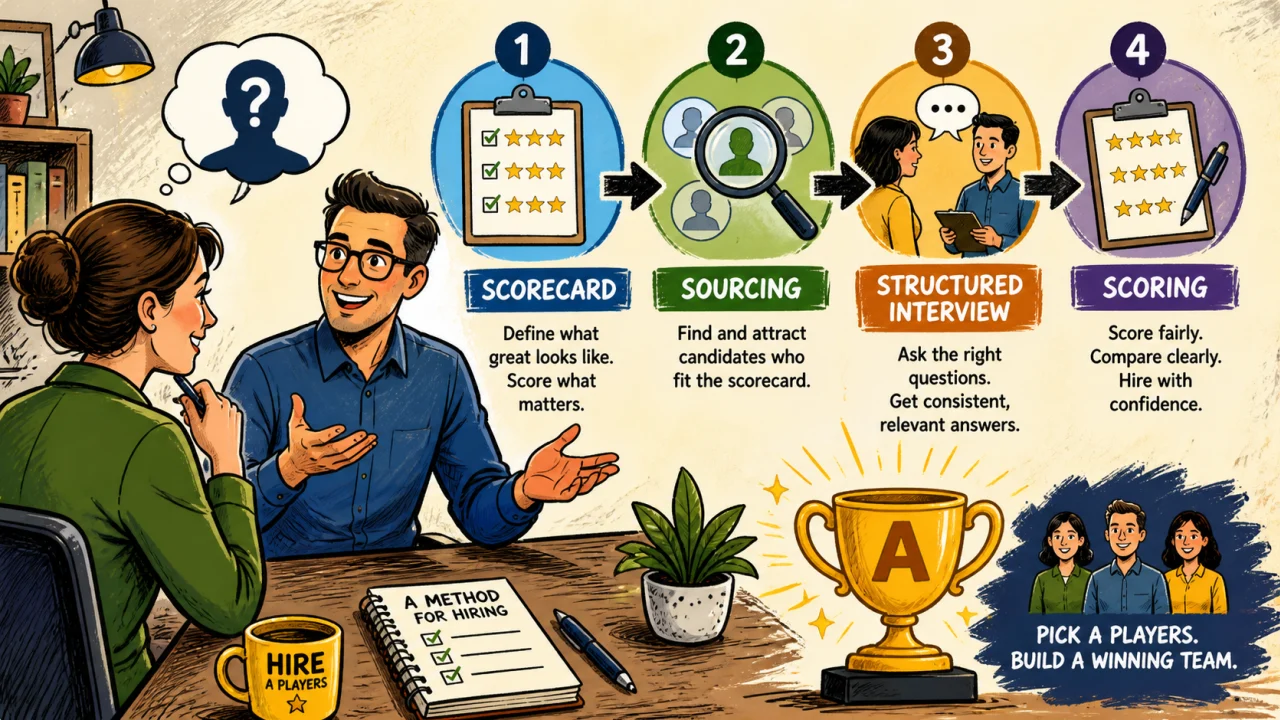
You just spent six weeks interviewing candidates, picked the one who felt right, and three months later they're already underperforming. The WHO interview method — built on the framework from Geoff Smart and Randy Street's Who: The A Method for Hiring — exists to fix exactly that problem. It replaces gut-feel decisions with a scorecard-driven process that claims a 90% success rate, based on 1,300 hours of interviews with hundreds of executives.
Here's how to actually run one, step by step.
Why Most Hiring Managers Pick the Wrong Person
Most interviews are conversations, not evaluations. You ask a few behavioral questions, the candidate tells a polished story, and you walk away thinking, "They seem great." That's not hiring. That's vibes.
The trouble is that unstructured interviews reward people who interview well, not people who work well. And those two groups don't overlap as much as you'd think.
What a WHO Interview Actually Measures
A WHO interview evaluates three things at every stage of a candidate's career: What they did, How they did it, and what Outcomes they produced. Instead of asking hypothetical "what would you do" questions, you're digging into what actually happened — job by job, year by year.
This approach surfaces patterns. Did the candidate consistently hit targets, or did they ride a hot market? Did they build teams, or inherit good ones? The WHO interview is designed to separate real performance from good storytelling.
What Makes an A Player Different From a Good Candidate
An A player isn't just skilled. They're someone who delivers strong results and fits your specific role and culture. A brilliant engineer who can't collaborate is a B player on a team that ships together. Context matters.
The WHO method forces you to define what "A player" means for this role before you ever meet a candidate. That definition lives on your scorecard.
Step 1 — Build Your Scorecard Before You Talk to Anyone
Skip this step and the entire method falls apart. Seriously — a WHO interview without a scorecard is just another unstructured conversation with fancier questions. This is the part most teams rush through, and it's the reason the method fails when it fails.
Define the Role's Mission and Desired Outcomes
Start with one sentence describing why this role exists. Not the job title. Not a list of duties. The mission.
Then write down 3–5 measurable outcomes you expect the new hire to achieve in their first year. Be specific. "Grow revenue" is useless. "Increase outbound sales pipeline by 30% within 12 months" gives you something to actually score against.
List the Competencies and Qualities You'll Score
Below the outcomes, list the competencies and personal qualities that matter for the role. Think about what separates someone who'd thrive from someone who'd just survive.
For a sales role, that might look like:
- Strong communication skills
- Self-motivation and persistence
- Market awareness
- Networking ability
- Cultural alignment with your team
Every item on this list becomes a line on your scorecard. If you can't score it, don't include it.
How to Use the 1–5 Scoring Rubric
Each competency gets a score from 1 to 5 during the interview:
| Score | Meaning |
|---|---|
| 1 | Vague answer, didn't address the competency |
| 2 | Some detail but lacked depth |
| 3 | Clear and relevant, could use more specifics |
| 4 | Detailed, showed strong understanding |
| 5 | Exceptional depth and real mastery |
The key here: score each answer right after the candidate gives it, not at the end of the interview. Memory distorts fast. Write it down while it's fresh.

Step 2 — Source Candidates Who Fit the Scorecard
You've got your scorecard. Now you need people worth scoring.
Why Referrals Outperform Job Board Applicants
Referrals consistently produce better hires because someone you trust has already vetted the person. Employee referral programs, personal networks, and business connections all surface candidates who come pre-screened in a way no résumé filter can match.
That doesn't mean job boards are useless — they widen your reach. But if you're only posting and praying, you're fishing in the wrong pond.
Keep a Running Talent Pool Even When You're Not Hiring
The best hiring teams don't start sourcing when a seat opens up. They keep an ongoing list of strong candidates they've met at industry events, through mutual connections, or in previous interview rounds. When a role opens, they already have names to call.
This cuts your time-to-hire dramatically and reduces the panic-driven bad hires that happen when you need someone yesterday.
Step 3 — Run the WHO Interview Itself
This is the actual sit-down conversation, and it looks different from a typical interview. You're not jumping between random questions. You're walking through the candidate's entire work history in order.
Walk Through the Candidate's Career History Job by Job
Start with their earliest relevant role and move forward chronologically. For each position, you want to understand the full picture — not just the highlight reel they rehearsed.
This chronological walkthrough is what makes the WHO interview distinctive. Patterns emerge that you'd never catch from a handful of behavioral questions. You'll see whether someone consistently grows in responsibility or stalls out. You'll notice if they always leave jobs after 18 months, or if they tend to blame former bosses for every departure.
The Three Questions You Ask at Every Stop
For each role on their résumé, ask:
- What were you hired to do? This tells you whether they understood their mandate.
- What did you actually accomplish? This is where you get measurable outcomes.
- Why did you leave? This reveals motivation patterns and whether departures were on their terms.
Keep digging. If they say they "grew the team," ask from how many to how many. If they say they "improved retention," ask for the before and after numbers. Vague answers get a low score. Simple as that.
Sample WHO Interview Questions You Can Steal
Beyond the three core questions, you can layer in:
- "What was your biggest accomplishment in that role?"
- "What was your lowest point, and what did you do about it?"
- "Who was your boss, and what would they say about your work if I called them?"
That last one matters more than you'd expect. Telling a candidate you plan to speak with former managers tends to sharpen their honesty considerably.
Step 4 — Score, Compare, and Decide
After the interview, it's math time.
Tally Scorecard Totals Across All Interviewers
If multiple people on your team interviewed the candidate, collect all scorecards and compare totals. Look for consensus, but also pay attention to disagreements — they usually point to something worth discussing.
A candidate who scores 4s across the board from three interviewers is a stronger signal than one who gets a 5 and a 2. Consistency matters.
Red Flags That a High-Scoring Candidate Is Still Wrong
Numbers don't catch everything. Watch for these warning signs even when scores look good:
- The candidate can't name a specific failure or low point (too polished, possibly dishonest)
- Every success story credits them alone, never a team
- Their outcomes sound impressive but came during a boom period when everyone's numbers looked great
That last point is one most WHO interview guides don't talk about. A sales rep who crushed quota during a market expansion may not perform the same way in a flat or contracting market. Dig into the context of their results, not just the results themselves.

Where the WHO Interview Method Falls Short
No hiring method is perfect, and pretending otherwise doesn't help you.
It Doesn't Work Without a Real Scorecard
If you skip Step 1 or write a vague scorecard with items like "good communicator" and no scoring criteria, you'll end up right back where you started — making subjective calls and justifying them after the fact. The scorecard is the backbone. Without it, the WHO interview is just a long conversation.
Candidates Who Interview Well but Performed in Easy Markets
The WHO method leans heavily on past performance as a predictor of future results. But past performance happened in a specific context — a growing company, a hot industry, a strong manager. Strip away those tailwinds and the candidate's track record might not transfer. Always ask what was happening around them, not just what they did.
WHO Interview vs. STAR Method — When to Use Which
The STAR method (Situation, Task, Action, Result) zooms into a single scenario. You ask the candidate to describe one specific experience and break it down into four parts. It's great for probing a particular competency.
The WHO interview covers a candidate's full career arc. It's broader and takes longer, but it reveals patterns that STAR can't.
Here's the practical split: use STAR when you need to evaluate one or two specific skills in a focused interview. Use the WHO method when you're making a final hiring decision and want a complete picture of someone's track record. They aren't rivals — they solve different problems.
Common Mistakes That Tank Your WHO Interview Results
Skipping the Pre-Screen and Wasting 90 Minutes
A full WHO interview can run 60–90 minutes. Running one with every applicant is a terrible use of your time. Do a quick phone screen first — 15 to 20 minutes — to confirm baseline fit before you invest in the full walkthrough.
During that pre-screen, ask about career goals and salary expectations. If there's a clear mismatch, you've saved both sides an hour.
Scoring After All Interviews Instead of Right After Each One
This is the most common mistake, and it's deadly. If you wait until you've seen five candidates before scoring any of them, you're comparing memories, not data. Score each candidate immediately after their interview while the details are sharp. Then compare scorecards at the end.
Frequently Asked Questions
What is the process of a WHO interview?
The WHO interview follows four steps: build a scorecard defining the role's mission and competencies, source candidates through referrals and talent pools, run a chronological career-history interview scoring What, How, and Outcomes at every role, then tally scores across interviewers to make a data-driven hire.
How long does a WHO interview take?
Plan for 60 to 90 minutes for the interview itself. Add 15–20 minutes for the pre-screen phone call and another 15 minutes for post-interview scoring. The scorecard-building step (Step 1) typically takes 30–60 minutes but only happens once per open role.
Can you use the WHO interview method for entry-level roles?
Yes, but you'll need to adjust. Entry-level candidates don't have a deep career history to walk through. Focus the chronological portion on internships, school projects, and part-time work. The scorecard still applies — you're just weighting potential and learning speed more heavily than past outcomes.
Is the STAR method outdated compared to the WHO method?
No. They serve different purposes. STAR isolates a single competency in depth, while the WHO interview maps a candidate's full career pattern. Most hiring teams benefit from using both — STAR for focused skill checks and the WHO method for final-round evaluations.