You've got a Harvard interview scheduled, and you're Googling every possible question so you can rehearse perfect answers. Here's the thing: most Harvard interview questions aren't designed to stump you. They're designed to let an alumni volunteer figure out who you are when you're not hiding behind a polished application essay.
That distinction changes how you should prepare. Instead of memorizing scripted responses, you need to understand what the interviewer writes about you afterward — and what admissions officers actually read.
Why Your Harvard Interview Questions Prep Is Probably Backward
Most students spend hours perfecting answers to predictable prompts. That's not wrong, exactly. But it misses the point of how Harvard's interview system works.
What Alumni Interviewers Actually Do (They're Not Admissions Officers)
Harvard interviews are conducted by alumni volunteers, not by anyone who works in the admissions office. Your interviewer graduated from Harvard, lives in your area, and agreed to have a conversation with you — usually at a coffee shop, over the phone, or on a video call. According to Harvard College's own student tips page, you should think of it as a casual conversation, not a formal evaluation.
Here's the part most prep guides skip: your alumni interviewer doesn't have access to your application. They haven't read your essays, seen your transcript, or looked at your test scores. They're meeting you cold. That means repeating something you wrote in your personal statement isn't redundant — it's the first time they're hearing it.
The Report Alumni Write After Your Interview
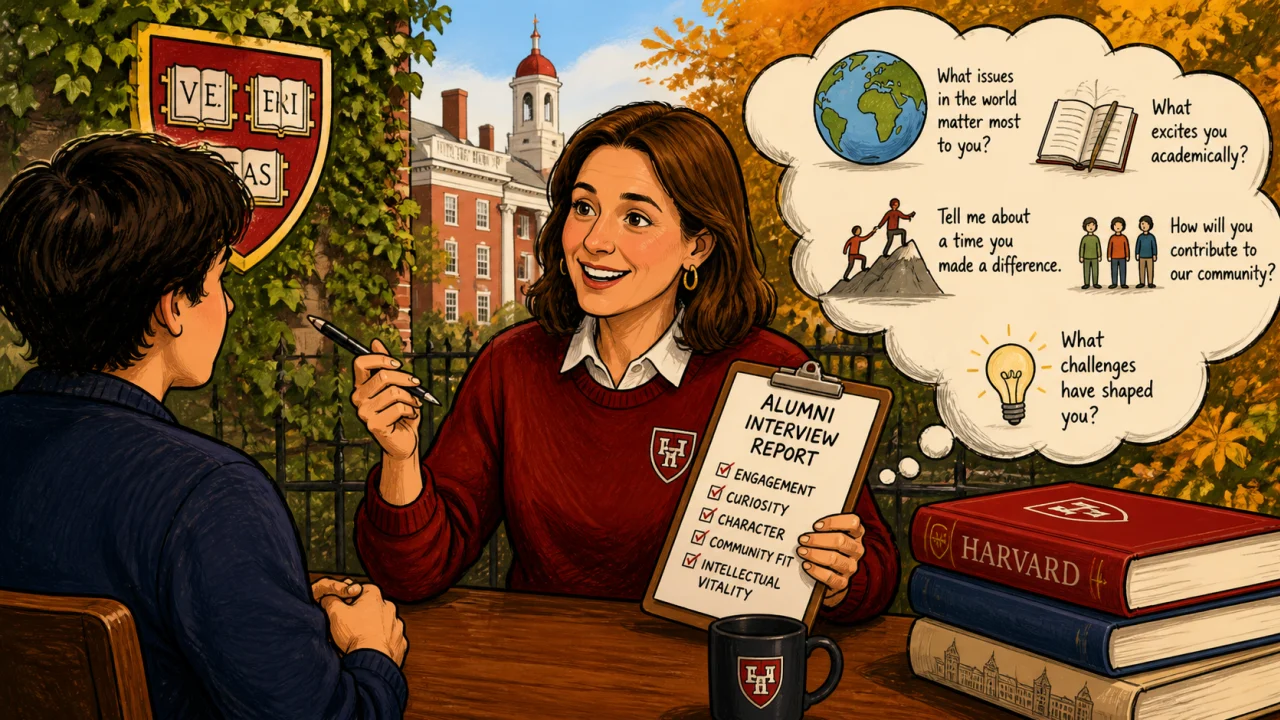
After every interview, the alumnus writes a report and submits it to Harvard's admissions committee. This report includes their overall impression of you — your personality, your intellectual curiosity, and whether the conversation felt genuine. Admissions officers read these reports alongside your full application. The interview won't make or break your admission on its own, but a strong report adds a human dimension that grades and scores can't.

The Harvard Interview Questions You'll Almost Certainly Hear
Based on what applicants have shared on forums like Reddit and what prep resources consistently list, a handful of questions show up in nearly every Harvard alumni interview. Here are the ones you should be ready for.
Tell Me About Yourself
This is almost always the opener. Don't recite your resume. Pick 2 or 3 things that matter to you — an activity, a turning point, a weird interest — and connect them into a short story about who you are right now. Sixty seconds is plenty. If you talk for five minutes straight, you've already lost the conversational rhythm.
Why Harvard?
They want specifics. "Because it's a great school" tells them nothing. Name a program, a professor's research area, a student organization, or a residential house tradition that genuinely interests you. The more precise your answer, the more believable it sounds.
What Was the Hardest Challenge You've Faced?
This isn't about drama. A small obstacle you handled thoughtfully beats a big crisis you describe vaguely. Focus on what you did, what you learned, and how it changed the way you approach problems.
What Do You Do Outside of School?
They're not looking for a laundry list of clubs. Talk about what you actually enjoy, even if it's not "impressive." Cooking dinner for your family every Thursday says as much about you as leading Model UN — maybe more, depending on how you frame it.
What's a Book You Read Recently That Stuck With You?
Have a real answer ready. Title, author, and a sentence or two about why it mattered to you. Don't pick a book just because it sounds intellectual. Interviewers can tell when you're performing versus when you genuinely care about something you read.
Harvard Interview Questions That Catch You Off Guard
The predictable questions above are easy to prep for. These next ones are trickier because they don't have obvious "right" answers.
Who Do You Admire and Why?
This reveals your values. Whether you pick a family member, a historical figure, or a local teacher, what matters is explaining the specific qualities you respect and how they've shaped your own thinking.
How Do You Spend a Typical Weekend?
Sounds simple. It's not. This question peels back the curated version of yourself. If you spend Saturdays volunteering and Sundays doing SAT prep, fine — but if you also binge-watch cooking shows and play pickup basketball, say that too. Interviewers want to see a real person.
What Would You Change About Your High School?
A surprisingly revealing question. It tests whether you can think critically about your own environment without sounding bitter or entitled. The best answers identify a specific gap and suggest what you'd do differently, not just what's wrong.

What the Alumni Interviewer Report Actually Covers
This is the part most applicants never think about, and it's arguably the most useful thing to understand when preparing for Harvard interview questions.
Personality and Character Impressions
The alumnus isn't grading you on a rubric. They're writing a subjective impression of what you're like to talk to. Were you warm? Curious? Did you listen, or just wait for your turn to speak? These soft impressions carry real weight because they're the one part of your application that comes from a live interaction.
Academic Curiosity Beyond Grades
Your transcript shows what classes you took. The interview shows whether you actually care about learning. If you light up when talking about a biology experiment you ran at home or a history rabbit hole you fell into over the summer, that energy comes through. Flat, rehearsed answers about "pursuing academic excellence" do the opposite.
How You Talk About Your Interests vs. How You List Them
Here's the contrarian takeaway most prep advice won't give you: the interview report often matters most for students whose applications look strong on paper but feel generic. If your activities list reads like a checklist — debate, volunteer hours, student government — the interview is your chance to prove there's a real human behind those bullet points. The alumnus can write, "This student talked about debate with more passion and nuance than I expected," and that single sentence can shift how an admissions officer reads your entire file.
3 Things That Hurt You More Than a Wrong Answer
You can't really give a "wrong" answer to most Harvard interview questions. But you can absolutely leave a bad impression.
Sounding Rehearsed Instead of Real
If your answers sound like you memorized them from a prep website, the interviewer will notice. It's fine to practice — just don't perform. A slight pause before answering actually makes you sound more thoughtful, not less prepared.
Not Asking the Interviewer Any Questions Back
This is a conversation, not a deposition. When you don't ask anything in return, it signals that you're not genuinely curious about Harvard or the person sitting across from you. Have at least 2 or 3 questions ready.
Treating It Like a Job Interview Instead of a Conversation
Stiff posture, formal language, and corporate-sounding answers make you forgettable. Harvard interviews typically last about an hour and are meant to feel relaxed and informal. Lean into that. You're a high school student talking to a person who went to the school you want to attend — not a candidate in a boardroom.
Smart Questions to Ask Your Harvard Interviewer
IvyWise recommends coming in with a few questions for your interviewer. Good options include:
- What did you enjoy most about your time at Harvard?
- What's your biggest piece of advice for incoming freshmen?
- What are alumni in my field of interest doing after graduation?
- What surprised you most about campus life?
Avoid asking anything you could easily find on Harvard's website. That tells the interviewer you didn't bother to look.
Does Getting a Harvard Interview Change Your Odds?
How Many Applicants Get Interviewed (the Real Number)
Top colleges like Harvard extend interviews to as many as 70% of their applicant pool. Getting an invite doesn't mean you're a frontrunner — it means an alumni interviewer in your area had availability. Don't read it as a signal about your chances.
What Happens If You Don't Get an Interview Invite
Your application is considered complete without the interview. Harvard states this clearly. Whether you get an interview depends on alumni volunteer availability in your geographic area, not on the strength of your application. Students in rural areas or outside the U.S. are less likely to receive an invite, and that won't count against them.
FAQ
Is It Rare to Get a Harvard Interview?
No. A large share of applicants receive interview invitations — estimates suggest up to 70% at top schools. It depends on whether an alumni interviewer is available near you, not on your application strength.
How Long Does a Harvard Alumni Interview Last?
Most Harvard interviews run about an hour, though they can be shorter or longer depending on how the conversation flows. There's no strict time limit.
Can a Bad Interview Keep You Out of Harvard?
A poor interview alone is unlikely to sink an otherwise strong application, but a notably negative alumni report can raise concerns. The bigger risk isn't bombing a question — it's leaving no impression at all. A forgettable interview helps no one.