
You open the admissions portal and realize registration, fees, and document upload deadlines all fall on different days—and you've already spent an afternoon just figuring out what you're supposed to do right now. The college personal application process has five main stages, but each one hides details that are easy to confuse. This guide breaks the full timeline into roughly 12 weeks of action items so you can follow along without missing a beat.
What is a college personal application? A college personal application is an admissions pathway where you use your standardized test scores to pass an initial screening, then compete for a spot through a portfolio of application materials and, in many cases, an interview. The full process—from registration to final enrollment—spans about 12 weeks.

Key Takeaways: 5 Things You Must Not Forget
- You'll pay two separate fees—a registration fee to the central admissions body and a review fee to each individual program.
- You can list up to 6 programs. Run a match analysis before you finalize your choices.
- Round 1 screening is based on your standardized test scores multiplied by each program's weighting factor—not a simple total score ranking.
- The document upload portal closes at a hard deadline with no exceptions. Late submissions are not accepted.
- The order you rank your acceptances during final enrollment directly affects where you end up. Don't fill it in carelessly.
What Does the College Personal Application Process Actually Involve?
The college personal application lets you go on offense. After your standardized test scores clear a program's initial cutoff, you make your case through application materials and interviews. Compare that to score-only placement, where a computer ranks everyone by their scores and assigns spots—no interviews, no portfolio. The personal application route caps you at 6 program choices; score-only placement lets you list far more. The two routes don't cancel each other out. If you don't get in through personal applications, you can still pursue score-based placement.
How the Timeline Breaks Down
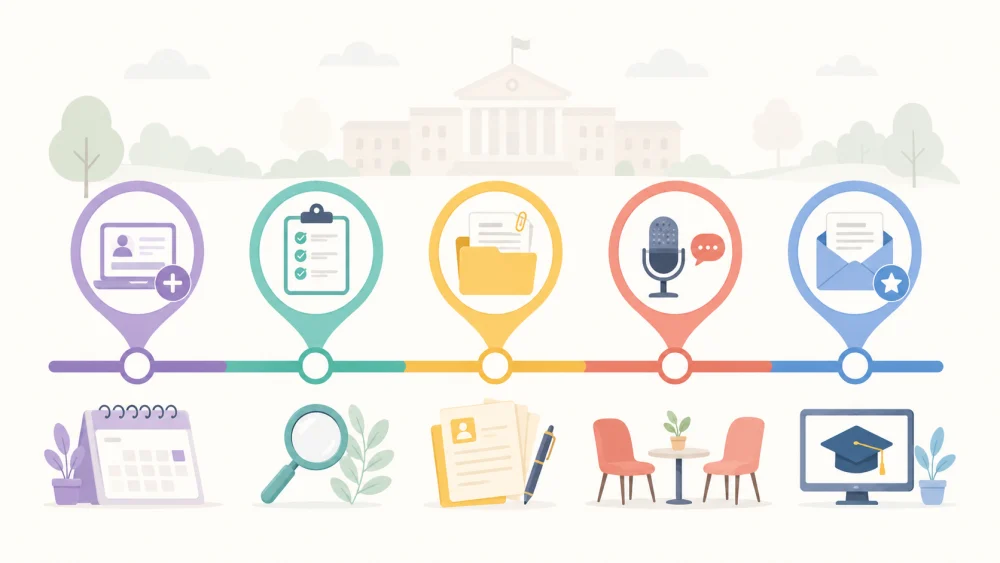
The broad structure is consistent year to year: registration and fees open in early March, Round 1 results post in late March, document uploads and interviews run from April through mid-May, acceptance decisions come out in early June, and final enrollment wraps up by mid-June. Add all of those dates to your phone calendar right now and set a reminder three days before each one.
Registration (Weeks 1–2): Fees, Program Selection, and Submission
You register through the central admissions portal using your test ID and government-issued ID number. The first thing to do is pay the registration fee—don't spend hours agonizing over your program list before you've locked in your spot.
How to Pick 6 Programs Without Wasting Slots
I've tested two free match-analysis tools: one gives you a clean interface where you enter your scores and get a ranked list of programs you're likely to clear; the other shows more granular data, including each program's historical screening multipliers over the past three years. Run both and cross-reference the results. A solid strategy: 2 safe picks, 2 borderline picks, 2 reach picks. All safe picks wastes opportunity. All reaches is just gambling.
Two Fees, Two Deadlines—Don't Mix Them Up
The registration fee goes to the central admissions body and is a flat rate per applicant. The review fee goes directly to each program you apply to and typically runs anywhere from $15 to $50 per program depending on the school. These two fees have different deadlines, and missing either one voids that application slot. When you pay in person or online, double-check the amount and the program name on the payment receipt.
Round 1 Screening (Weeks 3–4): Waiting for the Cutoff Results
About two to three weeks after registration closes, Round 1 results are posted. There's not much you can do to influence that outcome at this point—but you can spend these weeks getting a head start on your application materials instead of waiting around.
How Screening Multipliers Actually Work
Say a program admits 30 students and sets a screening multiplier of 3x. That means up to 90 applicants advance to Round 2. The system ranks applicants by their scores in the specific subjects that program designates, from highest to lowest, and cuts off at position 90. If you're ranked 91st, you don't advance. Tie-breaking rules vary by program—some look at a second subject score, others pass everyone tied at the cutoff. Those rules are in each program's admissions handbook. Read them before you register, not after.
If You Don't Clear the Cutoff
Failing to advance on all 6 programs is rare, but it happens. If it does: don't panic. Score-based placement is still available, and it typically has more open seats than the personal application route. Shift your energy toward preparing for the placement exam. If you clear 1 or 2 programs, focus entirely on the materials and interviews for those.
Application Materials (Weeks 5–8): What to Finish Before You Upload
This is the most time-consuming stretch of the entire process. You're typically putting together a personal statement, a study plan, academic work samples, and documentation of extracurricular involvement. Some programs also ask for a short essay or a portfolio.
Official Academic Portfolio vs. Self-Made PDF: Which Should You Use?
If your high school maintains an official learning portfolio system where your coursework is uploaded and verified by faculty over three or four years, that carries inherent credibility with reviewers. A self-assembled PDF gives you more formatting freedom but lacks that institutional backing. If you've kept your school portfolio current, pull the pieces that best represent your strengths—don't scrap everything and start over. If your portfolio is sparse, a well-designed PDF can compensate, but be honest with yourself about which materials actually show your best work.
3 Formatting Mistakes That Hurt Your First Impression
No section headers on a text-heavy page. Reviewers read dozens of applications in a single afternoon. If they can't scan for structure, they'll miss your strongest points. Decorative backgrounds or ornate borders that compete with the text. The application is read on a screen; anything that reduces legibility hurts you. Low-resolution photos. Blurry or pixelated images look unprofessional when zoomed in on a monitor. If you're including photos, use files that are at least 150 DPI at the intended display size.
How Long Should Your Personal Statement and Study Plan Actually Be?
Most programs don't publish a hard word count. Based on publicly shared guidance from admissions faculty at multiple institutions, a personal statement in the 800–1,200 word range hits the right mark, and a study plan works best at 600–1,000 words. Shorter doesn't mean weaker—reviewers consistently say that sprawling, unfocused writing is a bigger problem than brevity. Pick your 2 or 3 strongest experiences and develop them fully. Listing 15 activities without depth helps no one.
Interview Preparation (Weeks 7–10): The First 90 Seconds Matter Most
Interviews are usually scheduled one to two weeks after the document upload deadline. Not every program includes an interview—check the admissions guide before you assume yours does. When interviews are part of the process, they typically count for 20% to 50% of your total score. That's too much to leave to chance.
The 5 Most Common Interview Questions—and How to Answer Without Sounding Rehearsed
"Tell me about yourself." Cap it at 90 seconds. Say who you are, why you chose this field, and what you bring to the program. "Why this program specifically?" Name at least one specific course or a faculty member's research focus. "This program has a great reputation" tells them nothing. "What's the most meaningful class you took in high school?" Choose something relevant to the program. Explain what you learned and how you've applied it. "Where do you see yourself in four years?" You don't need a ten-year plan. Talk about what you want to accomplish during your undergraduate years. "Do you have any questions for us?" Always have one ready. Ask about curriculum structure or internship opportunities. Saying "no" is a missed opportunity.
The underlying rule for every answer: be specific. Saying you're passionate about biology is filler. Describing the six-week science fair project you ran in 10th grade, what your hypothesis was, and what you found—that's memorable.
Online vs. In-Person Interviews: What Changes
Online interviews most often fail because of tech issues, not nerves. Test your camera, microphone, and internet speed the day before. Use a plain wall as your background. For in-person interviews, the biggest risk is arrival time—showing up late typically disqualifies you outright. Either way: maintain eye contact with the camera or the panel, slow your speech down, and keep each answer under two minutes.
Enrollment Decisions (Weeks 11–12): Don't Rush the Last Step
Acceptance results come in two categories: confirmed and waitlisted. A confirmed acceptance gives you a guaranteed spot—but you still have to log in and complete enrollment to claim it. Skipping that step means you lose the spot.
How Waitlist Movement Actually Works
Every year, applicants who hold confirmed spots at multiple programs can only enroll in one, which opens up seats for waitlisted candidates. Historically, applicants in the top 50% of a waitlist have a strong chance of getting in. If you're in the bottom half, the odds drop significantly—but it's not zero. Keep an eye on your email through the enrollment window.
When You Get Into Two Programs: The Decision Most People Regret
The most common mistake is choosing the school with the bigger name over the program that actually fits your interests. Students who pick a prestigious school for a major they feel lukewarm about often find transferring majors is harder than expected. Open the four-year curriculum map for both programs side by side and go through the required courses year by year. Ask yourself which set of classes you'd actually want to sit through. That's a more useful filter than rankings.
Two Things Most Application Guides Skip: Mental Health and Your Parents' Role
These don't show up in most how-to guides, but in my experience, they directly affect the quality of your materials and your interview performance.
When to Stop for the Day
If you've spent three consecutive days staring at your personal statement and can't change a single sentence, that's not a motivation problem—that's cognitive fatigue. Go outside, exercise, sleep a full night, and come back. You'll almost always spot what needs fixing within the first 30 minutes of a fresh session. Pushing through exhaustion doesn't produce better writing. It produces worse writing that you're too tired to notice.
Getting Your Parents Involved Without Starting Arguments
Set clear boundaries upfront: you make the decisions on program selection and content; they help with proofreading, deadline reminders, and fee payments. When roles don't overlap, conflict drops. If a parent is pushing hard for a specific program you're not sure about, bring the match-analysis data into the conversation. Numbers move the discussion faster than feelings do.
FAQ
How many programs can you list in a college personal application?
Up to 6. You don't have to fill all six slots, but most applicants do, since the review fee for each program is only charged after you clear Round 1 screening. Programs you apply to but don't advance past screening don't cost extra.
Can you still get in through personal applications if your test scores aren't great?
It depends on what "not great" means for your target programs. If your scores clear a program's screening multiplier, the personal application route actually gives you a chance to make up ground through your materials and interview. Pure score-based placement is often harder on mid-range applicants because there's no other factor in play.
What if you run out of time to prepare all your application materials?
Prioritize the 1 or 2 programs where you have the best shot and put your full effort there. More material doesn't mean stronger material. Two polished, targeted submissions beat six thin, rushed ones every time.
Does not getting in through personal applications hurt your score-based placement chances?
No. The two pathways are completely independent. Your personal application outcome has no effect on your eligibility or score calculation for placement. The only exception: if you've already accepted and enrolled through a personal application, you're no longer eligible for placement in the same cycle.
What should you wear to a college interview?
There's no dress code, but the safest choice is clean, neat casual clothing—think solid-color top with slacks or a skirt. No need for a suit, and avoid anything too casual like flip-flops or athletic wear. The goal is to keep the panel's attention on what you're saying, not what you're wearing.