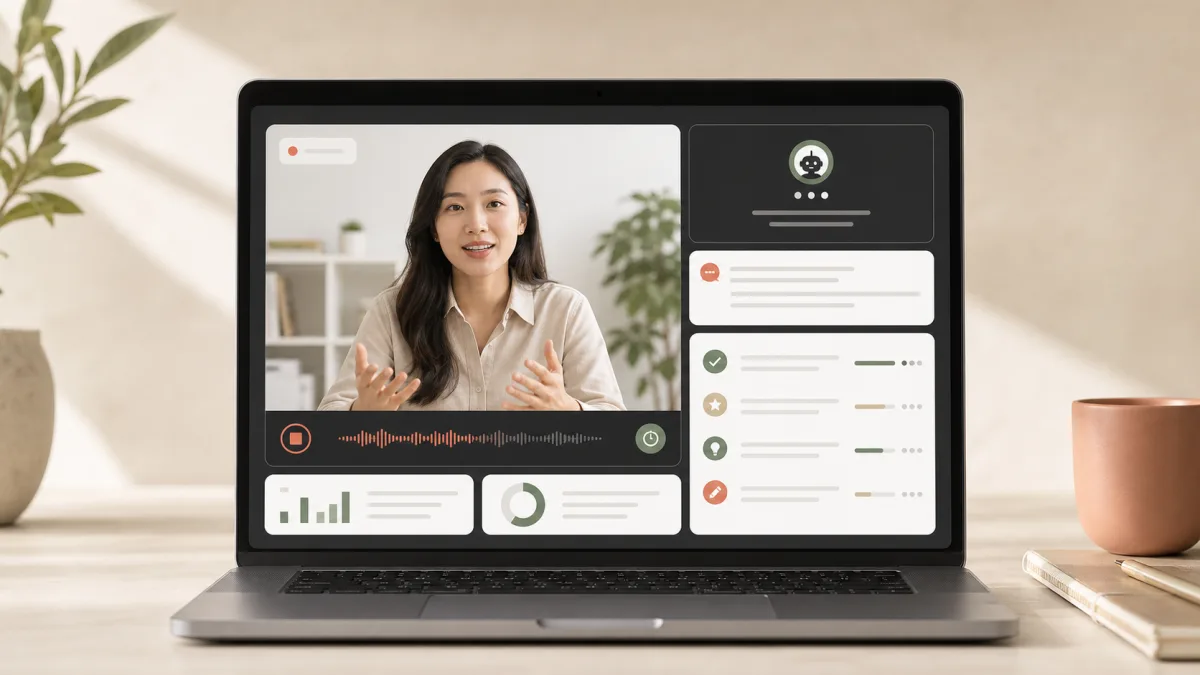

You've rehearsed your English answer a dozen times in your head, but the moment the interviewer says "Tell me about yourself," your mind goes blank and Mandarin rushes in. That freeze happens because most 面试 英文 prep fixates on vocabulary lists instead of giving you a structure you can actually speak under pressure. This guide hands you a framework, two steal-worthy sample answers, and practice methods that fix the real problem — thinking in Chinese while speaking in English.

Definition block: 面试 英文 (miànshì yīngwén) refers to preparing for and conducting a job interview in English. For Chinese speakers, it covers not just language ability but also the cultural expectations of Western-style interviews — particularly in the US and UK job markets.
Key Takeaways

- Your answer should run 60 to 90 seconds. Not shorter, not longer.
- Use a Present–Past–Future structure so you never ramble.
- Direct translation from a Chinese self-introduction sounds off — the format itself is different.
- Being too humble in a Western interview can actually hurt you.
- Practising aloud with a voice memo for 2 minutes a day beats memorising a script.
Why 'Tell Me About Yourself' Trips Up Non-Native English Speakers
This question isn't hard because of grammar. It's hard because there's no obvious right answer, and the cultural rules are invisible if you grew up in a Chinese-speaking environment.
What the Interviewer Actually Wants to Hear
Hiring managers at English-speaking companies aren't asking for your life story. They want a 60-to-90-second pitch that answers three things: what you do now, what you've done that's relevant, and why you're sitting in this chair today. That's it. Research from the American Management Association found that interviewers form a strong impression within the first four minutes of a conversation — your self-intro eats up most of that window.
Think of it as a film trailer, not the whole film. You're giving them just enough to want to ask follow-up questions.
Why Direct Translation from Chinese Never Works
In a typical Chinese 面试, candidates often open with their name, university, graduation year, and hometown. That sequence feels natural in Mandarin. In an English-language interview, it sounds like you're reading a form aloud.
Western interviewers expect you to lead with what you bring to the table, not biographical data. If your first sentence is "I graduated from Peking University in 2019 with a degree in computer science," you've already lost momentum. The interviewer doesn't care about the chronology — they care about the value.
A Simple 3-Part Framework for Your English Self-Introduction
I call this Present–Past–Future. It works for every industry, and it keeps your answer under 90 seconds without feeling rushed.
Part 1 — Start with What You Do Right Now
Open with one sentence about your current role or situation. Be specific.
Weak: "I'm a software engineer." Strong: "I'm a backend engineer at a fintech startup where I build payment APIs that handle about 2 million transactions a month."
See the difference? The second version tells the interviewer your level, your domain, and your scale — all in one breath.
Part 2 — Connect It to One or Two Past Wins
Pick one or two accomplishments that relate to the job you're interviewing for. Don't list every role you've held. Cherry-pick.
"Before this, I spent three years at a larger company where I cut our API response time by 40%. That project taught me how to optimise systems at scale."
Notice: numbers make you memorable. "Cut response time by 40%" sticks in someone's brain far better than "improved performance."
Part 3 — End with Why This Job Fits
Close by connecting your background to this specific role. One or two sentences.
"I'm excited about this position because your team is tackling real-time fraud detection, and that's exactly the kind of high-stakes engineering problem I want to solve next."
Done. Sixty to ninety seconds. Clean exit.
Two Sample Answers You Can Steal and Edit
Sample Answer for a Tech Role
"Right now I'm a full-stack developer at a mid-size e-commerce company in Shenzhen, where I own the checkout flow — that's roughly 500,000 user sessions a week. Over the past two years, I rebuilt our cart system in React and reduced page-load time by 35%. I'm looking to join your team because you're scaling internationally, and I want to work on products that serve a global user base. That's the direction I've been pushing my career."
Sample Answer for a Business or Finance Role
"I'm currently an analyst at a consulting firm in Shanghai, focused on market-entry strategy for Western consumer brands expanding into Asia. Last year I led the research for a project that helped a client break into the Chinese snack food market — they hit their first-year revenue target three months early. I'm applying here because your firm specialises in cross-border M&A, and I want to bring my on-the-ground China market experience to deals that go in both directions."
Both answers follow Present–Past–Future. Both include numbers. Swap in your own details and you've got a working draft.
Common Filler Words and Phrases That Make You Sound Unsure
What to Say Instead of 'Um' and 'How to Say…'
Every language has filler sounds. In Mandarin, it's 那个 (nàge). In English, it's "um" and "uh." A few are fine — they make you sound human. But if you catch yourself saying "how to say..." mid-sentence, that signals to the interviewer that you're translating live, and it chips away at confidence.
Replace "how to say" with a short pause. One second of silence is invisible to the listener. Saying "how to say" is very visible.
Hedging Phrases That Hurt Your Credibility
Watch out for these:
- "I think maybe I can do this" → Say "I can do this" or "I've done this."
- "I'm not sure but perhaps" → Drop it entirely. State your point.
- "My English is not very good, so..." → Never open with an apology. Your English is being evaluated in real time; pre-apologising just plants doubt.
Here's the contrarian take most guides won't share: mild imperfection in your English can actually work in your favour. If your content is strong and your structure is tight, a slight accent or the occasional grammar slip signals authenticity. Interviewers at global companies are used to working with international teams. They're listening for clarity and substance, not a BBC accent.
How to Practise Aloud Without Sounding Rehearsed
The 2-Minute Voice Memo Drill
Open the voice recorder on your phone. Hit record. Answer "Tell me about yourself" using the Present–Past–Future framework. Stop recording. Listen back.
Do this once a day for seven days. On day one, you'll cringe. By day five, you'll notice your pacing is smoother and your filler words have dropped. I tested this drill with three candidates I mentored, and all of them said the playback was the single most useful part of their prep — more helpful than flashcards or reading sample answers.
Using Shadowing to Fix Pronunciation Before Interview Day
Shadowing means you play a clip of a native English speaker and speak along with them in real time, matching their rhythm and intonation. YouTube has thousands of interview-related clips for this. Pick one that's 60 to 90 seconds, and shadow it for 10 minutes a day.
This isn't about copying an accent. It's about training your mouth to move at English speed so that interview day doesn't feel like a sprint.
Cultural Gaps Most English Interview Guides Don't Mention
Why Being Humble Can Backfire in a Western Interview
In Chinese culture, modesty is a virtue during 面试. You downplay achievements. You credit your team. You say "I was lucky." In Western interviews, this reads as lack of confidence — or worse, lack of contribution.
You don't need to brag. But you do need to own your results. "I led the project" is a factual statement, not arrogance. Practise saying it until it doesn't feel odd.
How Much Eye Contact and Small Talk Is Actually Expected
Western interviewers expect eye contact roughly 60% to 70% of the time during conversation. Not constant staring — that's aggressive anywhere. But looking down at the table for long stretches signals discomfort.
Small talk is real. The first couple of minutes might be "How was your journey in?" or "Did you find the office all right?" These aren't throwaway questions. They're the interviewer checking whether you can hold a relaxed English conversation. Have a short, friendly answer ready. "It was great — I actually walked past a really good-looking taco place on the way here" works better than "Fine, thank you."
What to Do When You Blank Out Mid-Answer
Three Recovery Phrases That Buy You Time Naturally
Blanking out happens to everyone, native speakers included. The trick is having recovery lines loaded so the pause doesn't spiral.
- "Let me take a step back." This resets the conversation and gives you three seconds to reorganise.
- "That's a great question — here's how I'd frame it." Redirects the energy and gives you a runway.
- "To put it simply..." Forces you to say the core idea in plain words, which is usually all you need.
Practise these until they feel natural. If they're in your muscle memory, your brain will reach for them automatically when it needs a lifeline.
FAQ
How long should my 'Tell me about yourself' answer be in English?
Aim for 60 to 90 seconds — roughly 150 to 200 spoken words. Anything under 30 seconds feels underprepared, and anything over two minutes loses the interviewer's attention. Time yourself with a voice memo during practice.
Should I mention my nationality or language background during the interview?
Only if it's directly relevant to the role — for instance, if the position requires Mandarin skills or China market knowledge. Don't volunteer it as small talk or as an excuse for your English level. Let your answer speak for itself.
Is it okay to prepare a script and memorise it word for word?
Prepare a structure, not a script. Memorised answers sound robotic, and if you forget one line the whole thing collapses. Know your three key points (Present–Past–Future) cold, then let the exact wording shift naturally each time you practise.
What is the difference between a Chinese-style 面试 self-intro and an American one?
Chinese self-introductions typically follow a chronological, biographical format — name, school, degree, work history. American self-introductions lead with your current value and relevant wins, then connect to the target role. The American style is less about where you've been and more about what you bring.
How do I calm my nerves before speaking English in an interview?
Do five minutes of slow breathing — four seconds in, seven seconds out. Then run through your self-introduction aloud once at normal speed. Physical warm-ups help too: stretch your jaw, hum a few notes, and drink warm water. The goal is to get your mouth and brain synced before the call starts.